

You invested in a professional website. The design is clean, the partners are happy with it, and it represents the firm well. And yet the contact form stays quiet, and your website still isn't generating leads.
Here is the uncomfortable truth: a website that looks good and a website that wins business are not the same thing. Looking credible gets your firm considered. Turning visitors into conversations is a separate job, and most professional-services sites simply are not built for it.
This post walks through the most common reasons a professional-services website fails to generate leads, and the practical fix for each.
Looks fine, performs poorly: why credible sites still don't convert
A website can be attractive and still fail at its most important job, which is turning visitors into leads. A polished design earns a moment of trust, but that trust only matters if the site then makes it easy to take the next step. Looking credible is essential, and our website design essentials for credible firms covers that groundwork. Credibility alone, though, does not generate inquiries. The numbers show how quickly visitors decide.
By the numbers
- Visitors form a first impression of your website in about 50 milliseconds, and that judgment is driven largely by visual design.
- On mobile, as page load time goes from 1 second to 3 seconds, the probability that a visitor bounces rises 32%; by 10 seconds it rises 123%.
- More than half of all web traffic now comes from mobile devices, so a weak mobile experience affects most of the people who reach you.
Reason 1: Your positioning is unclear
Within seconds of landing on your site, a visitor should know who you help, what you do, and why you are the right choice. When the homepage leads with vague language like "full-service solutions for a changing world," prospects cannot tell whether you serve firms like theirs, so they leave to look elsewhere.
The fix: State, in the first thing visitors see before they scroll, exactly who you serve and the outcome you deliver. Name your niche. Replace clever taglines with a clear value proposition a busy prospect can absorb in one read.
Reason 2: Your calls to action are weak or missing
A visitor who is ready to act needs an obvious next step. Many firm sites hide contact options or offer only a generic "Contact Us" in the footer, which asks a lot of someone who is still deciding. If the path forward is not clear, even interested visitors drift away.
The fix: Give every key page one clear primary call to action. Make it specific and low-friction, such as "Schedule a 20-minute consultation" or "Request a proposal," and repeat it where decisions happen.
Reason 3: There is no clear path to convert
Even motivated visitors need a route from interest to inquiry. If your site is a set of pages with no guided journey, no lower-commitment options, and a single long contact form, you lose everyone who was not ready to commit on the spot. Most prospects are not.
The fix: Map the journey. Offer lower-commitment steps, such as a guide, a checklist, or a short assessment, alongside the "talk to us" path. Keep forms short, and add contextual entry points throughout the site.
Reason 4: The site is too slow
Speed is invisible until it costs you. Visitors abandon slow pages before they ever read your message, and search engines push slow sites down the results. As noted above, a jump from a one-second to a three-second mobile load makes a visitor 32% more likely to bounce.
The fix: Test your site's speed with a free tool like Google PageSpeed Insights, which grades it for you. Compress images, remove heavy scripts and unnecessary plugins, and use modern hosting. Aim for a page that feels instant on a phone, not just on office wifi.
Reason 5: The mobile experience is poor
More than half of your visitors are on a phone. If your site was built desktop-first, they land on cramped text, fiddly menus, and forms that fight back, and most of them leave. The lost inquiry is only part of the damage. Google now reads and ranks your site from its mobile version, an approach it calls mobile-first indexing, so a poor phone experience quietly drags down your search visibility as well. That means fewer rankings, fewer visitors, and fewer leads, all tracing back to the same weak spot.
The fix: Design mobile-first, so the site is genuinely good on a phone rather than a desktop layout squeezed to fit. Use buttons big enough to tap with a thumb, readable type, short forms, and click-to-call, then walk the real inquiry path on an actual phone before you call it done.
Quick diagnosis: symptom, cause, and fix
Use this table to match what you are seeing in your analytics to the likely cause and the first fix to try.
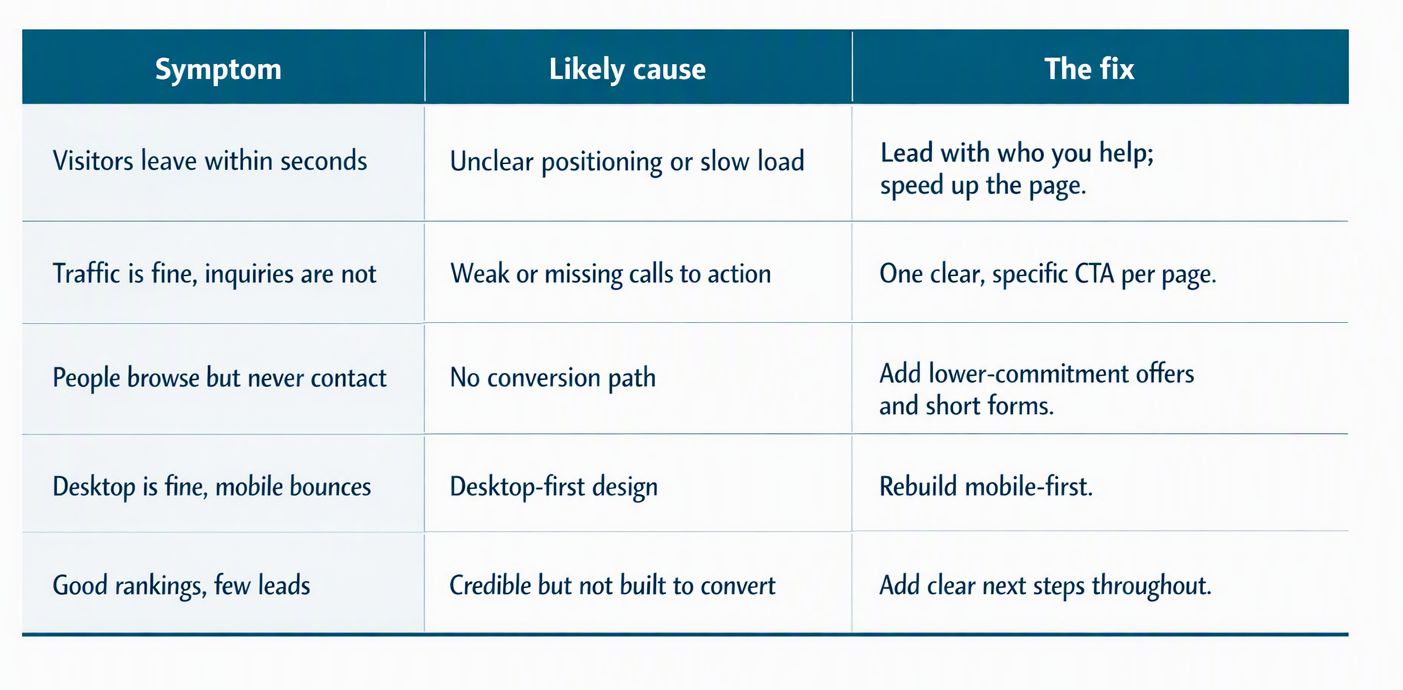
Common website lead generation issues, their causes, and practical solutions to increase conversions.
How Align Marketing Group can help
Align Marketing Group designs websites for professional service firms that are built to generate leads, not just to look the part. We sharpen your positioning, create clear conversion paths, and make sure the site is fast and mobile-first, so the traffic you already have turns into more conversations. It is part of the same approach we bring to marketing best practices for professional service firms.
If your website looks the part but the inquiries are not coming, we would be glad to take a look and talk through what to fix first. Contact Align today to start the conversation.