

Your firm has a portfolio full of strong work. The projects sit on your website, listed by name, sector, and square footage, and they still are not winning as much new work as they should. The problem is rarely the work itself. It is how the work is told.
In AEC, clients do not buy a list of buildings. They buy confidence that your team can solve their problem, on their site, within their constraints. A project story gives them that confidence in a way a project list never will.
This post shows how to turn your completed projects into client-facing stories, and where to put them so they actually win work.
Why storytelling wins work in AEC
AEC is a relationship and reputation business. Most of your work comes from people who already know you or were referred to you, and most selection decisions come down to one question: has this team solved problems like ours before? Your projects are the evidence. The firms that present that evidence as a story stand out in a field of look-alike qualifications.
By the numbers
- AEC firms derive 75 to 85 percent of their business from repeat clients and referrals.
- 86 percent of architects say existing clients arevery important to their firm's growth over the next three years.
- Stories are more persuasive and better remembered thanfacts and figures alone, according to Stanford research on storytelling.
A strong AEC marketing strategy makes these stories easy to find, reuse, and put in front of the right clients.
A project story is not a project list
A project list tells the reader what you built. A project story tells them what you solved. That difference decides whether a selection committee remembers your firm an hour after they close your proposal.
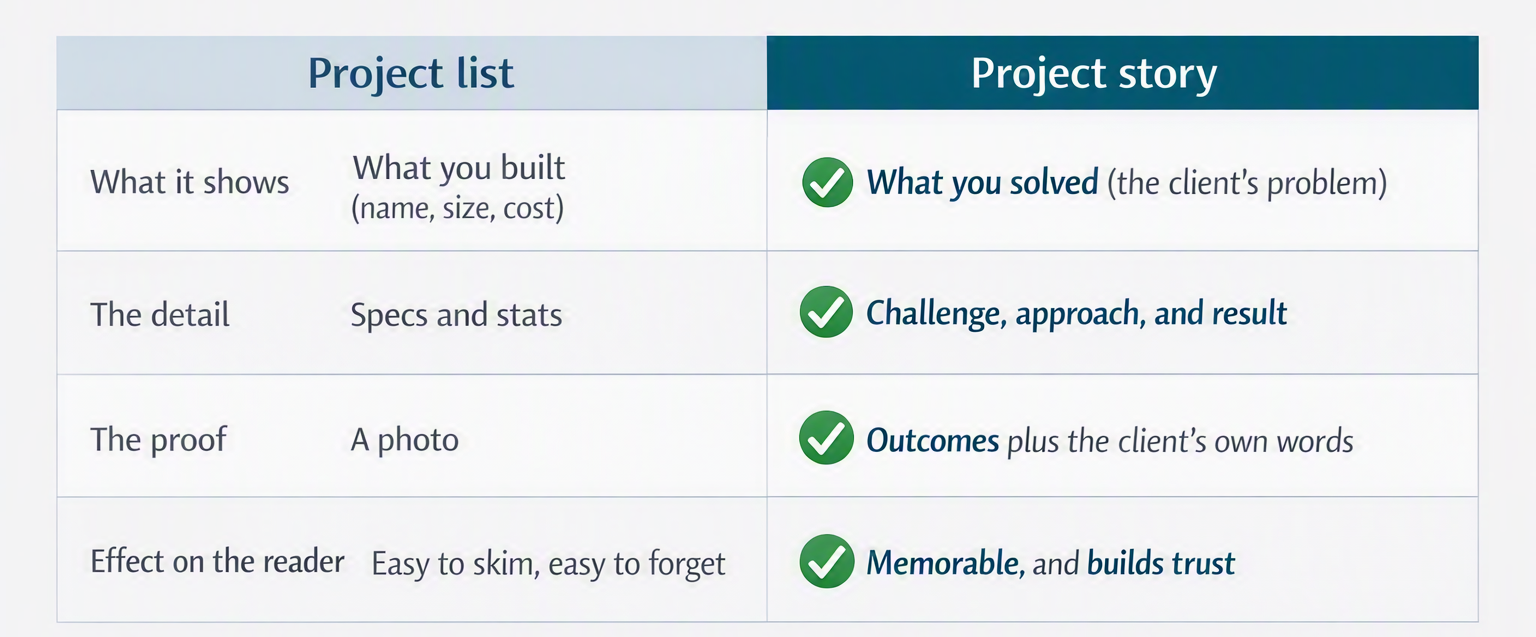
The anatomy of a winning project story
Every strong project story has three parts. Keep them tight; most stories should fit on a single page or a few minutes of a presentation.
1. The problem
Start with the client's situation and the challenge they faced: a tight urban site, an aggressive schedule, difficult soil, a fixed budget, or a community that needed convincing. This is what makes the reader lean in, because it sounds like their problem.
2. The process
Show how your team approached it: the decisions you made, the trade-offs you weighed, and how you worked with the client and the other disciplines. This is where your judgment shows, and judgment is what a client is really hiring.
3. The outcome
Close with the result in concrete terms: delivered two months early, came in under budget, cut energy use by a third, opened in time for the school year, or won a community award. Add a short client quote if you have one. Real numbers and a real voice turn a claim into proof.
Real example: CR-BPS
CR-BPS, a building-performance and building-science firm, is a good illustration. Their old website was outdated and hard to find, so prospects never saw the depth of their project work. As part of a redesign, we built them a dedicated Client Stories section that turns individual projects into short problem, process, and outcome narratives, written around the terms their clients actually search. After launch, page views rose 20 percent, engagement on key service pages improved, and more referral and organic visitors became inquiries. The work did not change; the way it was told did. (See the full CR-BPS case study).
Where to use your project stories
Write the story once, then adapt its length for each place it needs to live:
- Proposals and RFP responses, especially the project descriptions and relevant-experience sections, where most firms just list specs.
- Your website, as real case studies rather than a photo gallery.
- Award submissions, which reward a clear problem-and-result narrative.
- Conference talks, webinars, and LinkedIn posts that build your firm's reputation between pursuits.
- Shortlist interviews and business development conversations, where a well-told story is more memorable than another slide of logos.
If you are weighing whether this kind of content is worth the effort, our related post on whether content marketing works for AEC firms makes the case.
How to capture stories before they fade
The best time to capture a project story is while it is still fresh and the team remembers the details. Build a simple habit so the work does not fall to memory months later:
- Hold a short debrief at project close: what was the challenge, what did we do, and what was theresult.
- Collect a client quote while goodwill is high.
- Keep before-and-after photos and a few hard numbers.
- Store it where marketing and business development canactually find it.
A firm that does this turns every finished project into an asset it can sell with for years, not a line on a list.
How Align Marketing Group can help
Align Marketing Group helps AEC firms turn their best projects into stories that win work, across proposals, websites, and thought leadership. We know the proposal-driven, relationship-based way AEC firms are selected, so we build stories that speak to selection committees, not just to other marketers. It is part of how we approach content development and marketing for AEC firms.
If your portfolio is stronger than your win rate, we would be glad to help you tell it better. Connect with Align Marketing to learn more.